
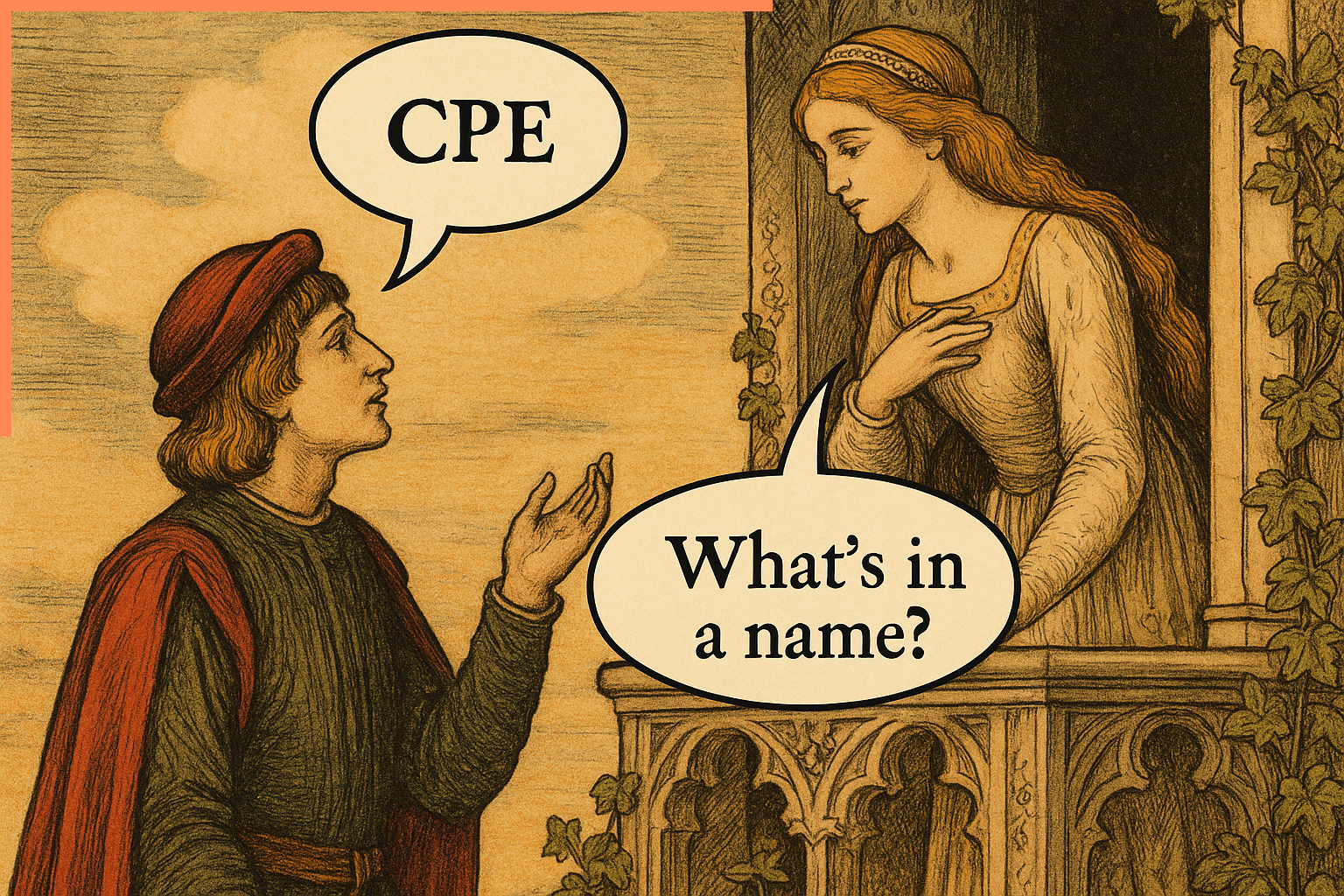
Shakespeare might say a name means nothing, but try telling that to someone googling a Cambridge exam in 2025.
We recently took a closer look at the search terms people use to find our website. And what stood out? Even today, a large portion of users in the Netherlands still search for terms like “CAE exam”, “CPE”, or “FCE”. And it’s not just a local trend, these old names are still widely used around the world, by students, teachers, and institutions alike.
If someone searches specifically for a Cambridge exam, chances are they’ll use one of the old acronyms: CAE, CPE, or FCE. Terms like C1 Advanced or B2 First are barely used in actual searches. People either type in a broad phrase like “Cambridge exam”, or they go straight for the old names they already know … the ones that have been around for decades.
Which is surprising, given that Cambridge officially updated these exam names back in September 2017. CAE became C1 Advanced, CPE became C2 Proficiency and FCE became B2 First.
Here’s first a bit of context on why those old names are still so deeply rooted.
A brief history of the old names
The acronyms CPE, CAE and FCE have a long and respected history, which helps explain why they’re still so persistent in people’s minds and search behaviour today.
- C2 Proficiency, previously known as Cambridge English: Proficiency and the Certificate of Proficiency in English (CPE), was first introduced in 1913. It was designed “for Foreign Students who desire a satisfactory proof of their knowledge of the language with a view to teaching it in foreign schools.”
The exam took 12 hours, cost £3 (around € 391 in 2025 values), and was only open to candidates aged 20 or older. It included both a written and an oral section.

- B2 First, previously known as the Lower Certificate in English (LCE), First Certificate in English (FCE) and Cambridge English: First, was originally launched in 1939. It was created as a mid-level qualification to certify upper-intermediate users of English, and eventually became one of Cambridge’s most widely taken exams.
- C1 Advanced, previously known as Cambridge English: Advanced and the Certificate in Advanced English (CAE), was introduced in 1991.
It was developed in response to feedback from language centres that there was too great a gap between the existing B2 First and C2 Proficiency exams. C1 Advanced bridged that gap and quickly gained popularity as a university entrance qualification.
Over time, these names became strong international brands — printed on certificates, built into teacher training, featured in coursebooks, and used in school communication. They shaped how generations of students and educators talked about the exams.
So it’s no surprise that the old acronyms are still alive and well today. Not just in the minds of candidates, but in the everyday language of schools, forums, and above all: English teachers. These are the people who once took the CAE or CPE themselves, and who still instinctively pass those names on to their students. Even though Cambridge officially updated the names in 2017 to better reflect CEFR levels, the echoes of the old titles remain remarkably strong.
We saw something similar again in March 2024, when Cambridge replaced the term “Computer-Based” with “Cambridge English Qualifications Digital”. A logical and modern update, but most people still refer to it as the “computer-based exam”. And honestly, it still makes sense. That label feels right, especially when the alternative is still officially called paper-based.
Maybe we should just call that one the analogue exam. You know: pencil, paper, and a quiet exam hall.
Once again, we’re reminded: changing how something is named is one thing. Changing how people use that name takes time.
When Cambridge introduced the new names in 2017, I made sure that at the centre I was involved with at the time, we adopted the new names straight away. For me, it made sense: the CEFR levels (B2, C1, C2) offer a clear and widely recognised standard, and I believed that schools, students and teachers would benefit from that clarity. Not all exam centres were as quick to make the transition. Many took longer to update their websites, adjust communication materials, and change internal habits. Understandably so; updating takes time when you’re dealing with long-standing habits and established systems.
Now, eight years later, I still believe early adoption of the new names was the right call. Clear language helps build consistent communication. But how people talk about these exams, in classrooms, on school websites, in conversations between teachers and students, that shift happens much more slowly.
Because “CAE” isn’t just a name. It’s short, familiar, and deeply rooted in how people refer to these qualifications. It has a legacy. It appears on old certificates, in textbooks, and in school documentation. And perhaps most importantly: it sounds like an official, serious exam. “C1 Advanced” may be more accurate, but for many people, it doesn’t yet carry the same weight.
At talkingENGLISH, we try to bridge both worlds. On our website, we use both the old and new names, so no one feels lost. You’ll find the C1 Advanced exam (CAE), the C2 Proficiency exam (CPE), and yes: now available in digital format, even if you still search for “computer-based exam”.
We’re not alone in that approach. Cambridge themselves still refer to the old names in many of their official materials and on their own website. You’ll often see phrasing like “C1 Advanced, formerly known as Cambridge English: Advanced (CAE)” , a clear sign that they, too, recognise how persistent and familiar these terms remain for learners, teachers, and institutions around the world.
Even though the way people search online, and the way many teachers still talk about the exams, tends to favour the old names, it’s only natural for us, as an exam centre, to use the current CEFR-based terms. In our written communication we use the official names: C1 Advanced, B2 First, C2 Proficiency. In conversations with students and schools, however, we usually just say “the C1 exam” or “the B2 exam”: short, clear, and closely tied to how people now think about language levels and goals.
Still, on our website we’ve decided to continue using the old names in brackets for now. We love tradition, and we understand the sense of familiarity that comes with names like KET, PET, FCE, CAE, or CPE. They’ve been part of English education for generations, and even Cambridge still refers to them in their own materials.
Behind every level, those old names still echo. And honestly, we don’t mind. There’s history in them. A sense of identity. Over time, the new names will become more dominant, and that’s a good thing. But in education, change happens gradually, and with care. Some habits fade slowly. And some are worth keeping just a little longer.
Frank
What’s in a name? – What Juliet meant (and what that has to do with exams)
The phrase “What’s in a name?” comes from Shakespeare’s Romeo and Juliet. Juliet speaks these words in the famous balcony scene, questioning why her beloved Romeo must belong to the rival Montague family.
She says: “What’s in a name? That which we call a rose by any other name would smell as sweet.”
Her point: a name is just a label. A rose would still smell just as sweet, even if we called it something else. And Romeo would still be Romeo, no matter what his last name was.
Shakespeare uses Juliet to express a powerful idea: it’s what something is that matters, not what it’s called.
But in real life? Names do shape perception. When it comes to Cambridge exams, the label still affects how people think, feel, and search. “CAE” continues to sound familiar and trusted. “C1 Advanced” may be accurate, but not yet emotionally familiar.
So yes – a Cambridge exam is still the same, like a rose.
But change the name, and people may not recognise it the same way anymore.
 talkingenglish.blog