
Picture exam day. The invigilator hands out the booklets, the rustle of paper fills the room. Students hunch over their desks, pens scratching across answer sheets. Every now and then, a pen is held against the lips in thought, a quick glance at the clock, and back to writing. It’s a scene we all recognise: the classic, traditional exam moment.

Fast forward to today. The exam room is quiet, but there’s no paper rustling. Only the soft tapping of keyboards, students wearing headphones, fully focused on their Listening test. No thick stack of answer sheets, but a clean digital screen with built-in tools and a visible timer. The same Cambridge exam, but an entirely different experience.
And that brings us to the question more and more schools are facing: do we stick with the familiar paper-based exam, or move to the digital option?
The comfort of tradition: paper exams
For many students and teachers, paper still feels like the most natural choice. It’s what they’ve always known. Booklets being handed out, answers crossed out with a pen, the physical overview of a text in front of you. It creates structure and reassurance.
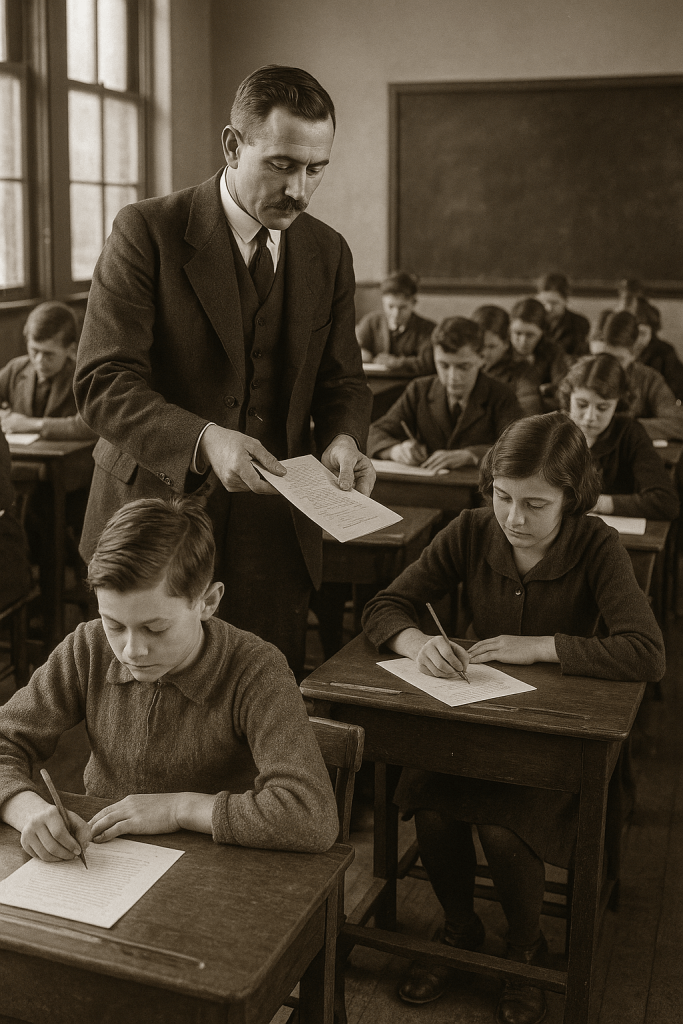
Teachers often feel this even more strongly. Their own studies were entirely paper-based. Paper feels tangible, reliable, and easy to control. Especially for Reading, it’s comforting to see the whole text and all the questions at once, without scrolling.
Paper, in short, provides confidence through tradition.
The ease of digital exams
Yet more and more students feel completely at home with digital exams. Typing is faster and more natural than writing. Editing is simple: they can cut, move and correct sentences without having to rewrite.
Listening is clearer with personal headphones, blocking out noise and allowing volume control. And the digital tools – highlighting, notes, a word counter – make the exam practical and efficient.
There’s also an important logistical advantage: flexible scheduling. While paper-based exams are tied to fixed exam dates, digital exams can be offered on more dates throughout the year. This gives schools and students much more freedom of choice.
Anxiety through the unknown
There is, however, one factor to consider: in the Netherlands, most school tests and final exams are still on paper. That makes the digital Cambridge exam feel unusual – and sometimes intimidating – simply because it’s different.
The nerves aren’t about the content, but about the unknown. “What if the computer crashes?” (no worries, everything is saved continuously) or “What if I’m not good with the software?” (no worries, the platform is simple and intuitive) are common worries.
But like most fears, it disappears once you know what to expect. After one practice session, students usually discover that the digital platform is easy to use. What began as anxiety often turns into relief, and sometimes even excitement.
As one of our candidates put it:
“I was nervous at first, but after one practice test I thought: oh, this is actually easier than on paper. Especially in Writing, I loved being able to type and edit.”
The teacher’s perspective

For teachers, moving from paper to digital also requires a mental shift. Where they once preferred a paper test booklet, they now see that their students are more comfortable behind a screen.
At first, some worry that their trusted preparation methods will suddenly need to change completely. In reality, the exam structure and content remain exactly the same. The way you prepare your students – teaching skills, exam strategies, practice tasks – does not change. What’s needed is simply awareness of how the digital exam looks and a chance for students to practise with it in advance. But no major changes are required in teaching or preparation.
Digital exams also offer clear benefits for schools: results are released much faster (within 5–10 days), allowing for quicker evaluation, faster communication with parents, and smoother planning overall.
Can the trend be stopped?
The reality is that more and more schools are switching to digital. Not because paper is wrong, but because digital fits better with the way students learn… and because the market is shifting. As demand for paper decreases, availability goes down and costs go up.
It’s likely just a matter of time before paper exams disappear altogether. How quickly depends on each country and each school, but in the Netherlands – where laptops are the norm – the move will be faster.
How schools can support students
The move to digital doesn’t have to cause stress. Schools can prepare their students by:
- Offering practice sessions with the digital exam software.
- Reassuring them that the content and certificate are exactly the same as paper-based.
- Highlighting the benefits, such as faster results, more flexible scheduling, and easier Writing and Listening.
This way, the digital Cambridge exam becomes not an obstacle, but a logical next step in a student’s learning journey.
What we do as an exam centre
At talkingENGLISH we are not only an authorised Cambridge exam centre. We are also a language institute with English as our core business. That means we know exactly how schools prepare their students for Cambridge exams, because we do the same every day.
That’s why we always go further: we share our know-how and provide the schools we work with extra practice materials and support. Together, we make sure students are fully prepared – academically, practically and mentally – for their exam, whether on paper or digital.
Conclusion: an exam for today
The choice between paper and digital is more than a practical question. It’s about emotion and experience. Paper provides reassurance through tradition; digital offers ease and reflects the world we live in today.
Ultimately, it comes down to one key question: are we preparing students for the past, or for the future?
Both formats are equally reliable and result in the same globally recognised certificate. But the trend is clear: digital is here to stay. And with the right preparation, it soon feels just as natural – if not more so – than paper.
Still, we don’t want to say goodbye to paper just yet. As modern as we are, there’s a certain nostalgia in handing out booklets and watching students write; a bit like reading a real book versus watching TikTok on your smartphone. Both have their charm, and for now, we’re happy to keep them side by side.
See all differences between paper-based and computer-based exams: https://cambridge-engels.nl/cambridge-english/paper-vs-pc/
 talkingenglish.blog